
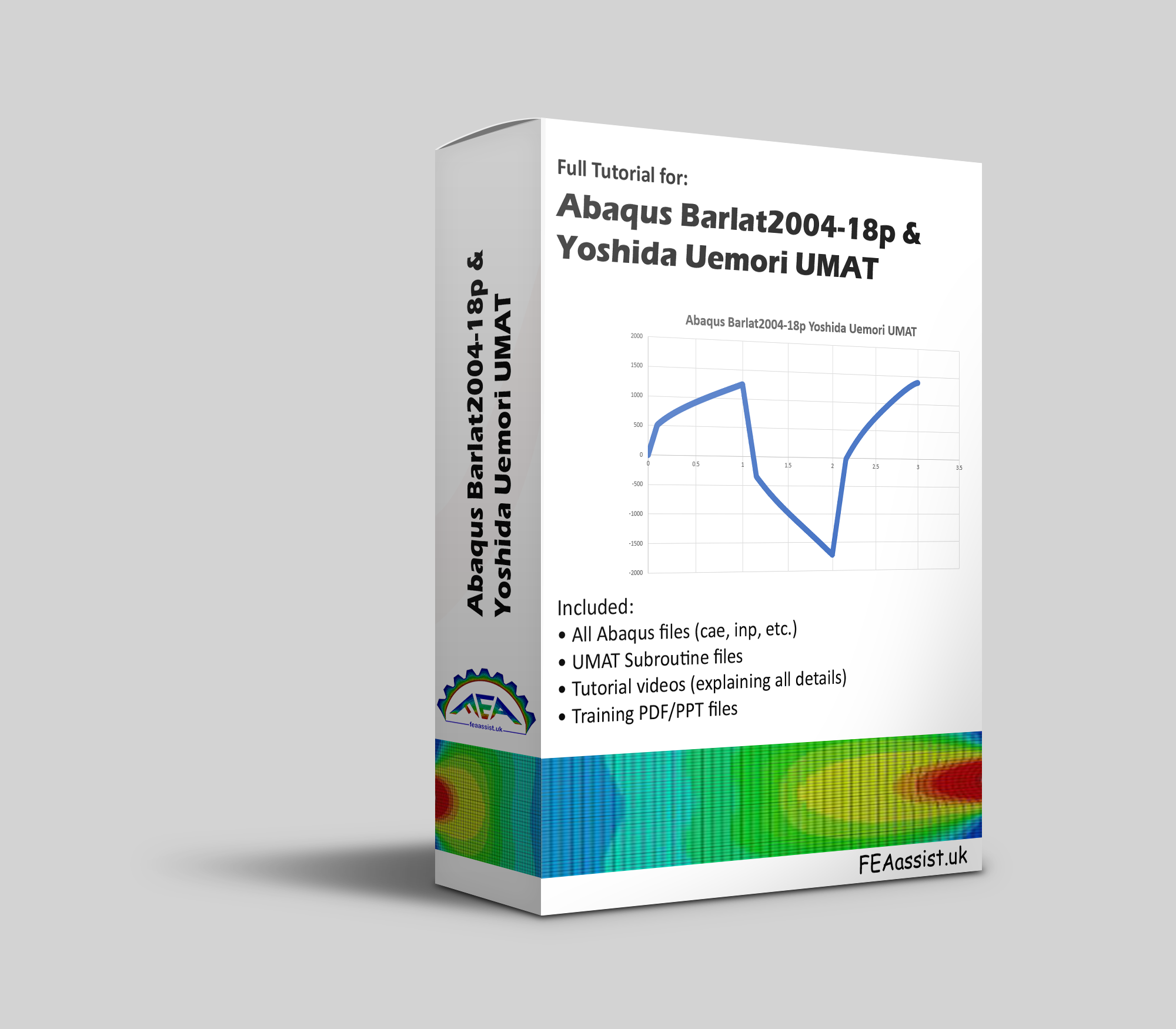
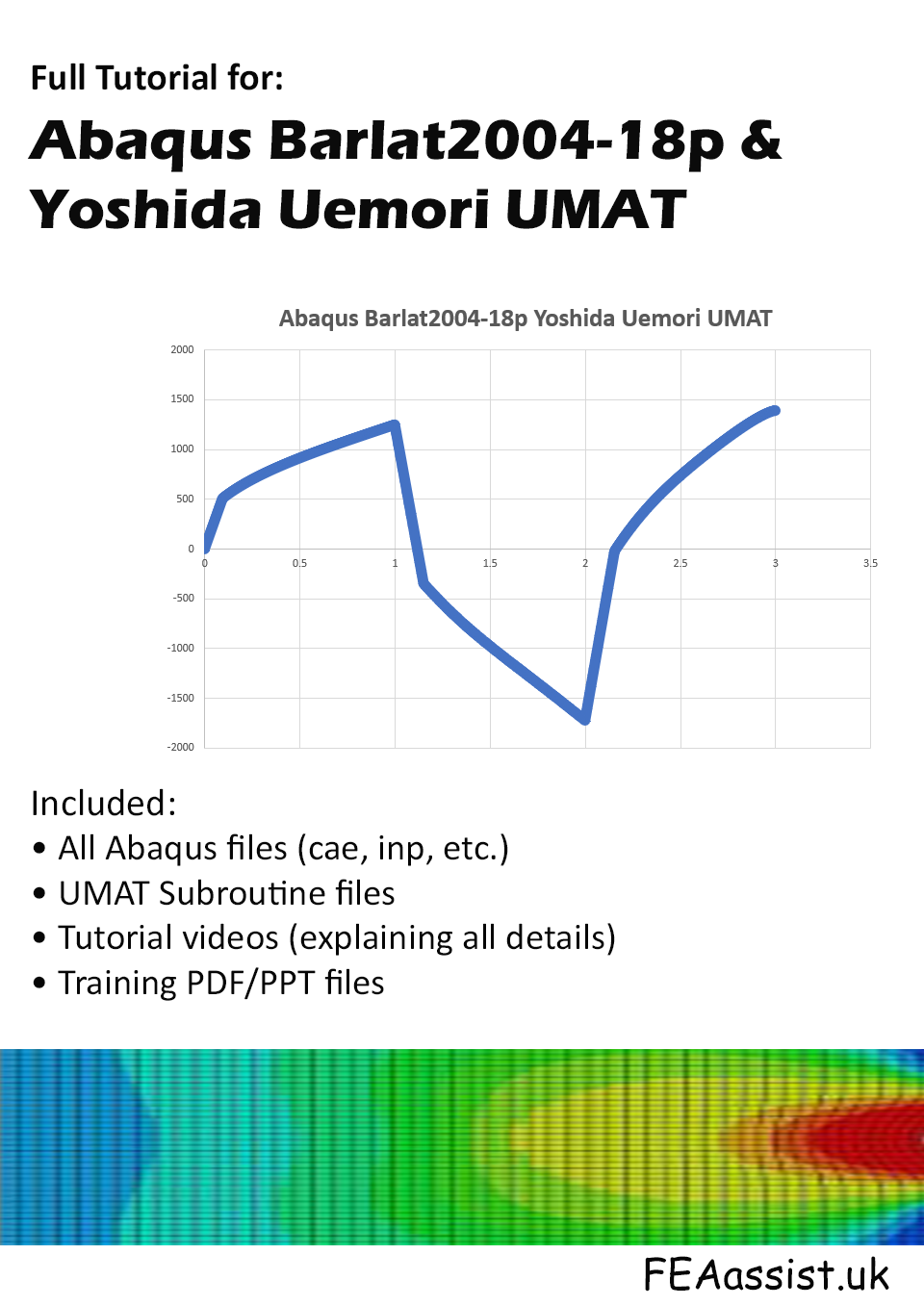
Description
Abaqus Barlat2004-18p Yoshida Uemori UMAT
Advanced Abaqus Barlat2004 UMAT with full Abaqus Yoshida Uemori UMAT integration. Includes accurate Barlat2004-18p Abaqus implementation and Yoshida Uemori kinematic hardening Abaqus model for cyclic plasticity, anisotropic yielding, and advanced sheet metal forming simulations. This package provides a complete Abaqus UMAT implementation of the Barlat2004-18p anisotropic yield function combined with Yoshida-Uemori kinematic hardening and Swift isotropic hardening, enabling accurate simulation of:
- Anisotropic yielding
- Bauschinger effect
- Back Stress
- Nonlinear isotropic hardening
- Cyclic plasticity
- Reverse loading
- Sheet metal forming processes
The framework follows the framework published in two papers of International Journal of Plasticity, 2002 and 2004 and is fully compatible with Abaqus/Standard developed by Dassault Systèmes [1,2,3,4], ensuring computational robustness.
Why Abaqus Barlat2004 UMAT & Abaqus Yoshida Uemori UMAT?
Modern sheet metals exhibit:
- Strong anisotropy
- Different yield stresses in different directions
- Bauschinger effect during reverse loading
- Nonlinear hardening
This package combines three powerful formulations to capture real material behavior:
| Model | Purpose |
|---|---|
| Abaqus Barlat2004 UMAT | Accurate anisotropic yield surface |
| Abaqus Yoshida Uemori UMAT | Kinematic hardening and Bauschinger effect |
| Swift hardening | Nonlinear isotropic hardening |
Formulation of Abaqus Barlat2004 UMAT & Abaqus Yoshida Uemori UMAT
1. Swift Isotropic Hardening
Defines evolution of yield stress:
where:
- K = strength coefficient
- ε0 = initial strain
- n = hardening exponent
- ε̄p = equivalent plastic strain
Hardening modulus:
2. Abaqus Yoshida Uemori UMAT Kinematic Hardening
Defines backstress evolution:
Captures:
- Bauschinger effect
- Reverse loading
- Cyclic plasticity
3. Abaqus Barlat2004 UMAT Yield Function
Yield condition:
where:
- λ′, λ″ = eigenvalues of transformed stresses
- m = exponent (typically 6–8)
Yield condition:
Flow rule:
Features
- ✔ Full Abaqus UMAT implementation
- ✔ Barlat2004-18p anisotropic plasticity
- ✔ Yoshida-Uemori kinematic hardening
- ✔ Swift isotropic hardening
- ✔ Fully commented source code
- ✔ Stable Newton return mapping
- ✔ Consistent tangent stiffness (DDSDDE)
- ✔ Ready-to-use Abaqus examples
What You Will Receive
- UMAT source code (.for)
- Abaqus input example files
- Material parameter template
- Detailed documentation
- Step-by-step setup guide
Applications
Ideal for simulation of:
- Sheet metal forming
- Deep drawing
- Springback analysis
- Cyclic loading
- Automotive sheet metals
- Aluminum alloys
- Advanced high strength steels (AHSS)
Abaqus Compatibility
- Abaqus Standard
- Abaqus 2017 – 2025
- Windows & Linux
Accuracy Advantages over von Mises
| Feature | von Mises | This Model |
|---|---|---|
| Anisotropy | No | Yes |
| Bauschinger effect | No | Yes |
| Reverse loading | Poor | Accurate |
| Sheet metals | Limited | Excellent |
Example Simulation Results
This model accurately predicts:
- Yield surface shape
- Stress-strain response
- Springback
- Reverse loading behavior
Who Should Use This Package
- Researchers
- Engineers
- PhD students
- Automotive engineers
- Metal forming specialists
Support Included
- ✔ Installation guide
- ✔ Parameter identification guide
- ✔ Technical support
Related Abaqus Services and Resources
We provide a complete range of advanced simulation services, including Abaqus consulting services, Abaqus UMAT development, Abaqus freelancing support, and expert Abaqus Help for complex nonlinear problems. Our implementations are grounded in peer-reviewed research published like International Journal of Plasticity and are fully compatible with Abaqus/Standard developed by Dassault Systèmes [1,2,3,4], ensuring numerical stability and industrial reliability. You can explore examples of our work and learning resources through our Abaqus Hydrogen modelling tutorial, Phase Field fracture tutorial, Abaqus plasticity implementation, and other specialised simulation tutorials designed to accelerate understanding and practical deployment.




Reviews
There are no reviews yet.