
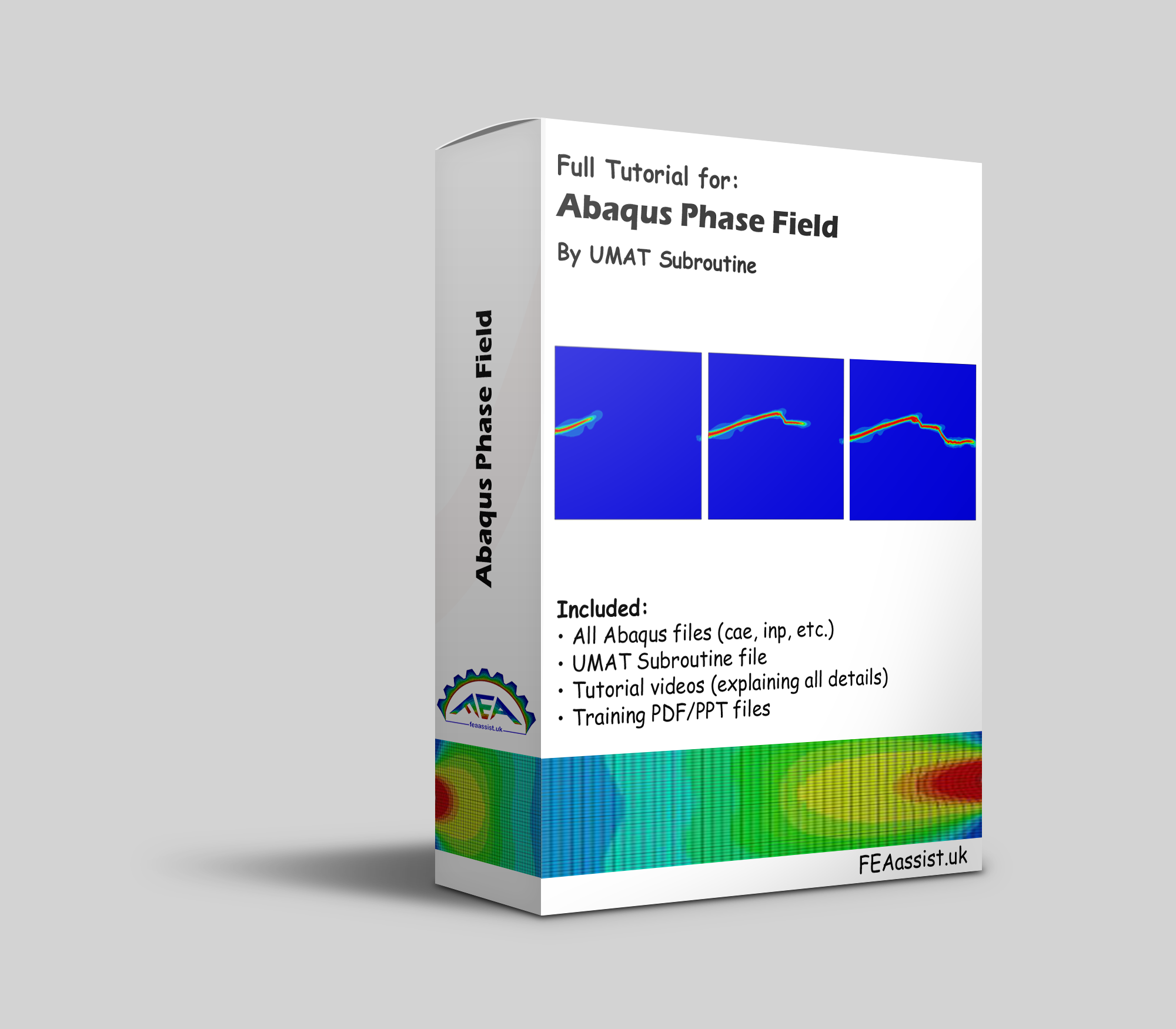

Description
Abaqus Phase Field Tutorial, Abaqus Phase Field Fracture
Theory, UMAT Implementation, and Validated Numerical Results
Abaqus phase field tutorial package (Abaqus Phase Field Fracture) provides a complete and practical guide to implementing the phase-field fracture method in Abaqus using a UMAT-based approach (Abaqus UMAT phase field). It is designed for researchers and engineers who want to understand the method, build reliable Abaqus models, and apply phase-field fracture to their own projects with confidence.
In this video, you will see the complete workflow, including UMAT implementation, Abaqus setup, mesh refinement strategy, and validated crack propagation results.
Why Abaqus Phase Field Fracture Is Challenging
Although the phase-field method is powerful, its implementation in Abaqus is not straightforward:
- Abaqus does not include a built-in phase-field fracture model
- Documentation [1,2,3] is limited and fragmented
- UMAT development is complex [4]
- Material and numerical parameters are highly sensitive
- Strict mesh refinement requirements apply
- Convergence issues are common
- Result extraction and interpretation are unclear
Many users spend weeks on trial-and-error without reliable results.
What Abaqus phase field tutorial package Solves
This package removes uncertainty and saves development time by providing:
- A clear explanation of the phase-field formulation
- A working UMAT implementation with detailed comments
- A fully configured Abaqus model
- Practical guidance on parameter selection and mesh refinement
- Stable solution strategies
- Clear post-processing and interpretation workflows
You learn why each step matters, not just how to run files.4
What You Will Learn
After completing this tutorial, you will be able to:
- Understand the theoretical background of phase-field fracture
- Set up Abaqus models correctly for phase-field simulations
- Implement and modify UMAT-based phase-field formulations
- Select appropriate material and numerical parameters
- Apply effective mesh refinement strategies
- Run stable simulations and diagnose convergence problems
- Extract and interpret crack paths, damage fields, and responses
- Adapt the model to your own research or engineering problem
What Is Included in Abaqus phase field tutorial package
The tutorial package includes:
- Step-by-step tutorial videos explaining the full workflow
- Complete Abaqus model explanation
- UMAT subroutine source code with detailed comments
- Abaqus files, input file (.inp), CAE file (.cae), etc.
- Fortran source files (.for)
- PDF documentation
- Guidance on result extraction and post-processing
All files are provided so you can reproduce the results and extend the model to your own applications.
Learning Format
- Structured video tutorials with clear explanations
- Practical demonstrations inside Abaqus
- Focus on understanding model behavior and numerical sensitivity
- Designed for efficient learning without unnecessary trial-and-error
This approach allows you to learn once and apply repeatedly.
Validation & Reliability
- Based on peer-reviewed scientific literature
- Numerical results validated against published references
- Suitable for academic research and engineering applications
This is a research-grade implementation, not a black-box demo.
Two Ways to Use FEAassist
Option 1 — Learn & Apply
Access the Abaqus Tutorial Package and:
- Learn the complete modeling workflow
- Understand the UMAT implementation
- Apply the method independently to your own project
This option is ideal if you want full control and long-term understanding.
Option 2 — Request a Custom Abaqus phase field fracture Project
If you prefer to save time and focus on results, you can request a custom Abaqus project:
- Your specific geometry and problem will be implemented
- Validated numerical results will be delivered
- Your desired outcomes will be produced
- The full workflow will be explained through tutorial videos and online meetings
This option provides both results and learning.
Who Abaqus phase field tutorial Is For?
- PhD & MSc students in fracture mechanics
- Researchers using Abaqus for advanced modeling
- Engineers interested in phase-field fracture
- Abaqus users struggling with UMAT implementation
Basic Abaqus and FEA knowledge is recommended.
Get Access
- Access the Abaqus phase field tutorial Package
- Request a Custom Abaqus Project
👉 Visit: https://feaassist.uk/contact
Frequently Asked Questions
Do I need prior UMAT experience for Abaqus UMAT phase field?
No. The UMAT structure and implementation are explained step by step.
Can I use this package for my own research project?
Yes. The provided files are designed to be adapted and extended.
Is this suitable for publication-oriented research?
Yes. The formulation and validation are based on peer-reviewed literature.
What Abaqus versions are supported?
The tutorial is compatible with standard Abaqus/Standard workflows. Specific version details are provided in the documentation.
Do you provide support?
Support is available through custom project requests and guided tutorial sessions.
Why Abaqus phase field tutorial Package Is Worth It
- Saves weeks or months of development time
- Avoids common modeling and numerical mistakes
- Provides a validated, research-level implementation
- Includes complete files, not partial examples
- Helps you apply the method confidently to your own work
Related Abaqus Services and Resources
We provide a complete range of advanced simulation services, including Abaqus consulting services, Abaqus UMAT development, Abaqus freelancing support, and expert Abaqus Help for complex nonlinear problems. Our implementations are grounded in peer-reviewed research published like International Journal of Plasticity and are fully compatible with Abaqus/Standard developed by Dassault Systèmes [1,2,3,4], ensuring numerical stability and industrial reliability. You can explore examples of our work and learning resources through our Abaqus Hydrogen modelling tutorial, Phase Field fracture tutorial, Abaqus plasticity implementation, and other specialised simulation tutorials designed to accelerate understanding and practical deployment.


Reviews
There are no reviews yet.